Reselling link building safely: policies, site selection and reporting
SEOReseller guide · Publishes · 4 min read
Short answer
Link building is only as safe as its methods. Google's spam policies treat links bought or exchanged to pass ranking credit as link spam, so paid placements should be qualified with rel="sponsored" or rel="nofollow". Resell link building only from partners who qualify sites on topical fit and real readership rather than DR alone, avoid networks and exchanges, and report every placement with its live URL, date and actual link attributes.
Key takeaways
- No method makes paid links that pass ranking credit "safe"; label paid placements.
- Qualify sites on relevance, readership, editorial context and placement conditions, not one score.
- Report attributes as published, so nobody misrepresents what was bought.
- Deliverables are verifiable placements; ranking changes are outcomes you can't promise.
We offer white-label link building, so we have a commercial interest. The policy points apply to every provider.
What Google's policies actually say
Google's spam policies describe link spam as links intended to manipulate rankings. Examples include buying or selling links that pass ranking credit, excessive link exchanges, large-scale article campaigns with keyword-rich anchor text, and automated link creation. Google asks that paid or sponsored links be qualified with `rel="sponsored"`, and also accepts `rel="nofollow"`.
A separate policy, site reputation abuse, covers third-party content published on a host site mainly to take advantage of that site's ranking signals. That matters when placements end up in sections of big sites created to sell content rather than serve their readers.
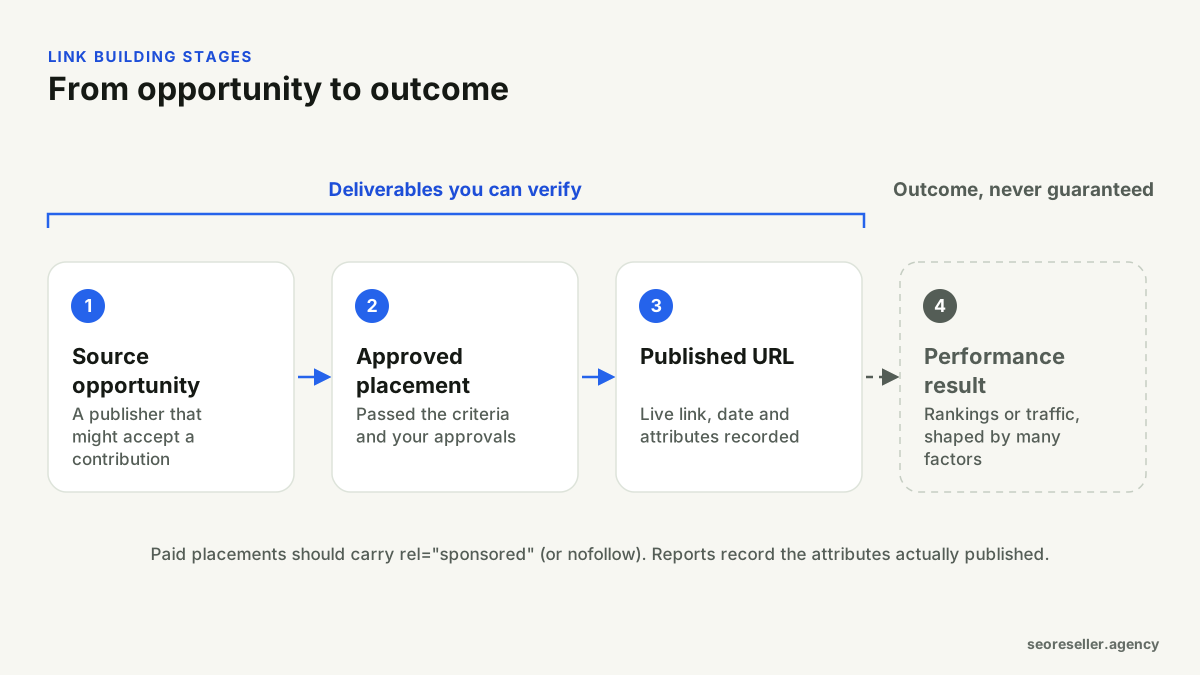
Four stages, only three of them deliverables
Confusion about what was bought causes most link-building disputes. Separate the stages in every conversation and report:
- Source opportunity: a publisher that might accept a contribution. Nothing promised.
- Approved placement: passed the selection criteria and any approvals in your scope.
- Published URL: live, with the date found and the attributes actually used.
- Performance result: any later ranking or traffic change. An outcome, never a deliverable.
Qualifying sites beyond DR and DA
Third-party authority scores estimate link strength. They're easy to inflate and say nothing about whether a site has readers or relevance. Use them as one input among several:
| Criterion | What to check | Warning sign |
|---|---|---|
| Topical fit | The site regularly publishes for the client's audience | Posts on every topic, from casinos to pet care |
| Readership | Traffic evidence with its source and the date checked | Estimates far out of line with visible engagement |
| Editorial context | Links sit inside content written for readers | "Write for us" pages selling links by DR |
| Placement conditions | Sponsored labelling, link attributes, edit/removal policy | Promises of "permanent dofollow" |
| Language and market | Matches the client's customers | Off-market audience |
Red flags when buying link building wholesale
- Guaranteed rankings, or "safe" or "guaranteed dofollow" links.
- Price lists sorted by DR with no information about readers.
- Private blog networks, link exchanges or "link packages" in bulk.
- Refusal to show where links will be placed or how they're labelled.
- Reports without live URLs or dates.
What every link report should show
- Live URL, target URL and anchor text for each placement.
- Link attributes as published, and any sponsored labelling.
- Why the site qualified, with the traffic evidence date.
- Replacements, with the reason and the original site.
- Anything still pending, clearly marked as pending.
There's a worked example in our sample placement report. For the full report structure, see what a white-label SEO report should include.
Explaining it to clients
Clients rarely ask about rel attributes, but they do ask "will this get us to page one?" An honest answer: link building can help a strong page earn visibility, it's one factor among many, and you'll show them exactly what was placed and where. That's a promise you can keep.
Before you resell link building
- Partner's selection criteria are in writing
- Paid placements are qualified, and reports show attributes as published
- No networks, exchanges or guaranteed rankings
- You approve target pages and anchor themes before work starts
- Replacement and removal terms are stated in the quote
- Your client proposal separates deliverables from outcomes
See how we scope it on the white-label link building page.