Reseller fundamentals
White-label SEO glossary: terms agencies meet when reselling SEO
SEOReseller guide · Publishes · 4 min read
Short answer
This glossary defines the terms agencies run into when reselling SEO: the business models (white-label, private-label, referral), link building vocabulary (placements, anchor text, rel attributes), local SEO (citations, NAP, service-area businesses), technical audit terms (crawling, indexing, canonicals, Core Web Vitals) and the commercial language of scope, units, margin and markup.
Key takeaways
- Third-party scores such as DR and DA are not Google metrics.
- Paid links should be qualified with rel="sponsored" or rel="nofollow".
- Margin and markup measure the same gap against different bases.
- A deliverable is something you can verify; a ranking change is an outcome.
Business models
- SEO reseller
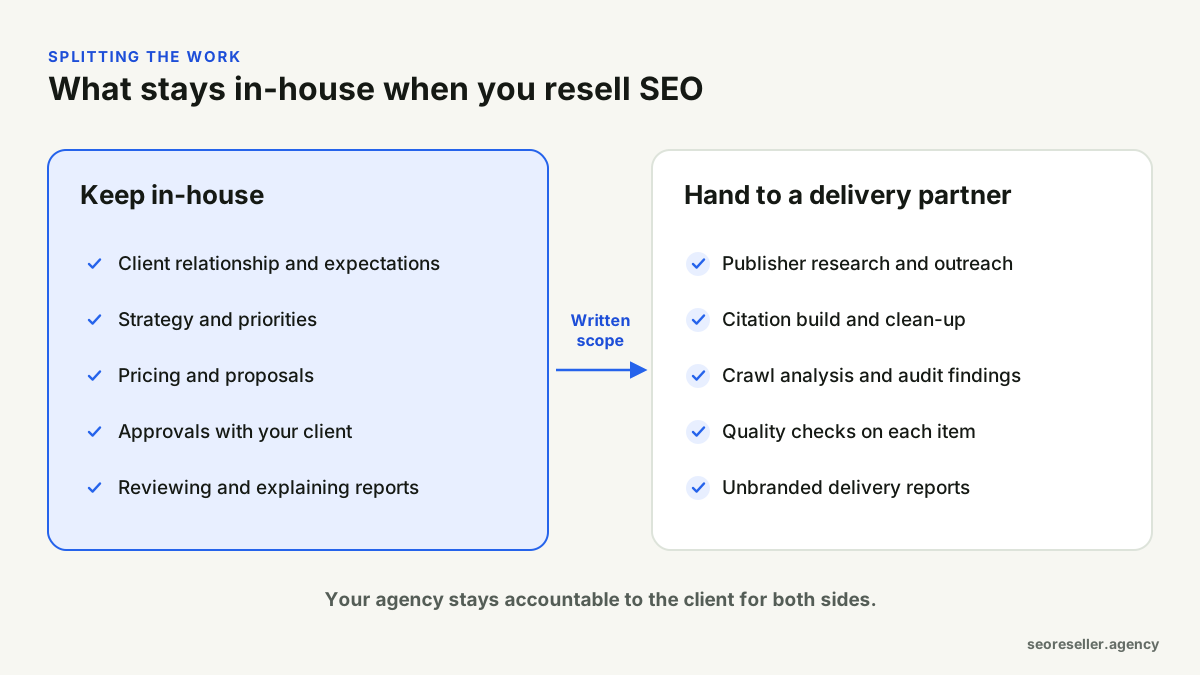
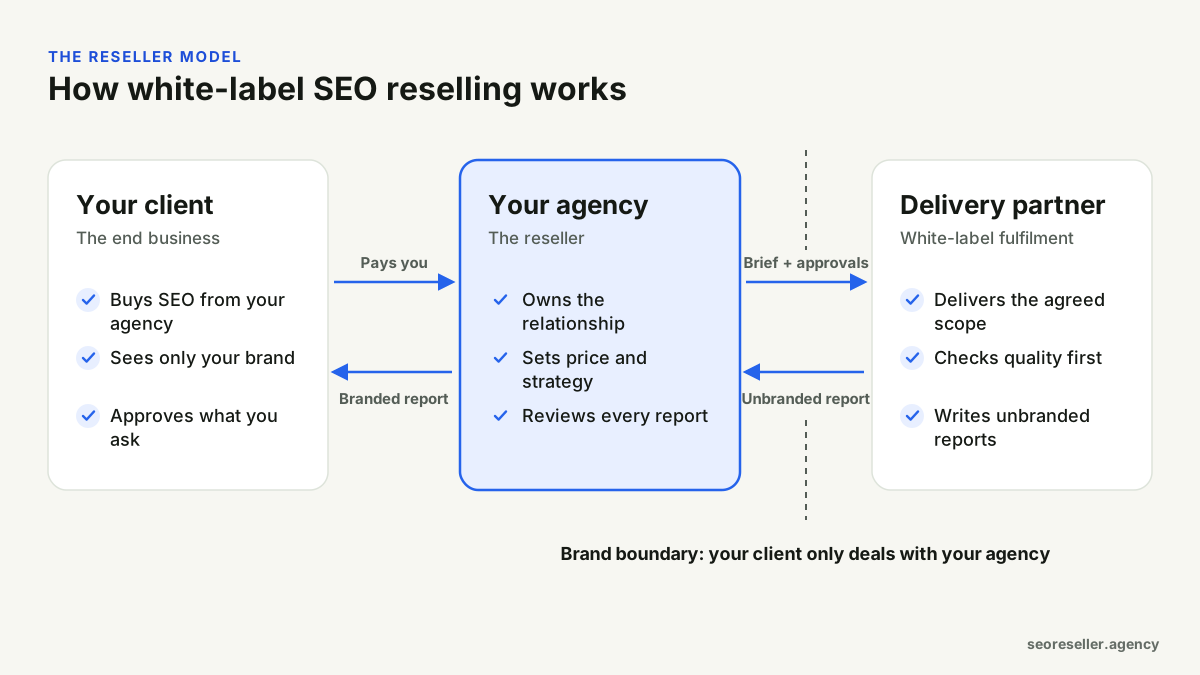
- A business that sells SEO services to its own clients while a separate partner delivers some or all of the work.
- White-label SEO
- Reselling where the delivery partner's brand never appears. The reseller presents the work and reports as its own.
- Private-label SEO
- Often used as a synonym for white-label; sometimes means a deeper arrangement with dedicated people or processes inside the reseller's operation.
- Fulfillment partner
- The business that actually delivers the resold work, under a written scope.
- Referral arrangement
- The reseller introduces a client to a provider, who then contracts with and serves the client directly.
- Affiliate
- Someone who earns a commission for sending customers to a provider. The customer belongs to the provider.
Link building
- Placement
- A link published on another website as part of a link-building order.
- Source opportunity
- A publisher that might accept a contribution. Nothing is agreed or promised yet.
- Target URL
- The page on the client's site that a link points to.
- Anchor text
- The clickable words of a link.
- rel="sponsored"
- The attribute Google asks publishers to use on links that are paid for or part of an advertising arrangement.
- rel="nofollow"
- An attribute telling search engines not to associate the linking site with the destination. Also acceptable for paid links.
- rel="ugc"
- An attribute for links in user-generated content, such as comments and forum posts.
- Link spam
- Google's term for links intended to manipulate rankings, including buying or selling links that pass ranking credit.
- Private blog network (PBN)
- A group of sites run mainly to create links to other sites. Treated as link spam.
- Site reputation abuse
- A Google spam policy covering third-party pages published on a host site mainly to exploit that site's ranking signals.
- DR / DA
- Domain Rating (Ahrefs) and Domain Authority (Moz): third-party estimates of link strength. Useful as one input; not used by Google.
Local SEO
- Google Business Profile (GBP)
- A business's listing on Google Search and Maps, managed by the business owner and anyone they invite.
- Citation
- A mention of a business's name, address and phone number on another site, such as a directory.
- NAP
- Name, address and phone number. Consistency across listings helps avoid confusion.
- Service-area business
- A business that serves customers at their location (a plumber, say) and can hide its address while showing a service area.
- Local pack
- The group of map-based business results that appears for many local searches.
- Manager access
- Permission the profile owner grants to another person or agency to edit a business profile, without sharing a password.
Technical SEO and audits
- Crawling
- How search engines discover pages by following links and sitemaps.
- Indexing
- Storing a crawled page so it can appear in search results. Crawled doesn't always mean indexed.
- Canonical URL
- The version of a page you want search engines to treat as the main one when similar versions exist.
- 301 redirect
- A permanent redirect from one URL to another, used when pages move.
- noindex
- A directive asking search engines not to show a page in results. It only works if the page can be crawled.
- robots.txt
- A file telling crawlers which paths they may fetch. It controls crawling, not indexing or access.
- Structured data
- Code that describes a page's content to search engines in a standard vocabulary (schema.org).
- Core Web Vitals
- Google's page experience metrics: Largest Contentful Paint (loading), Interaction to Next Paint (responsiveness) and Cumulative Layout Shift (visual stability).
- Search Console
- Google's free tool for site owners, showing search performance and indexing issues. Owners can add users with restricted access.
Pricing and operations
- Scope
- The written description of what will be delivered: units, inclusions, exclusions, inputs and terms.
- Deliverable unit
- The countable thing a price buys: a placement, a location, an audited site.
- Turnaround basis
- How delivery time is measured, and which steps (such as approvals) pause the clock.
- Contribution
- Price minus the total cost of delivering one account, before general overhead.
- Margin
- Contribution divided by price. A 2,000 price with 500 contribution is a 25% margin.
- Markup
- Contribution divided by total cost. The same example is a 33.3% markup.
- Pilot order
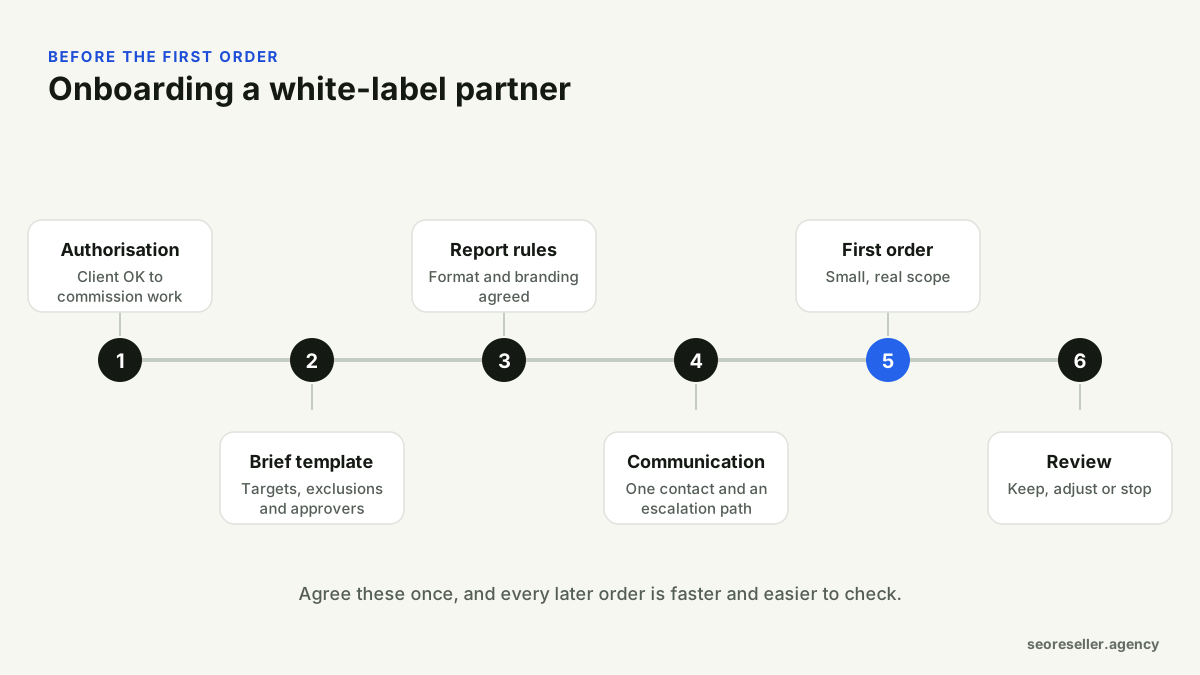
- A small, real first order used to test a partner's quality and communication.
For the commercial terms in practice, see SEO reseller pricing and the margin calculator. For delivery terms, see the sample reports.
Definitions here are written for agencies and kept deliberately short. Where a term relates to a Google policy, the policy itself is the authority.
Frequently asked questions
What's the difference between white-label and private-label SEO?
Both hide the partner's brand. Where a distinction is made, private-label usually means a deeper arrangement with dedicated people or processes inside the reseller's operation. See what an SEO reseller is.
Does Google use Domain Rating or Domain Authority?
No. DR and DA are scores created by third-party tool companies to estimate link strength. Google has its own systems and doesn't use these scores.