What is an SEO reseller? White-label, private-label and referral models explained
SEOReseller guide · Published · 4 min read
Short answer
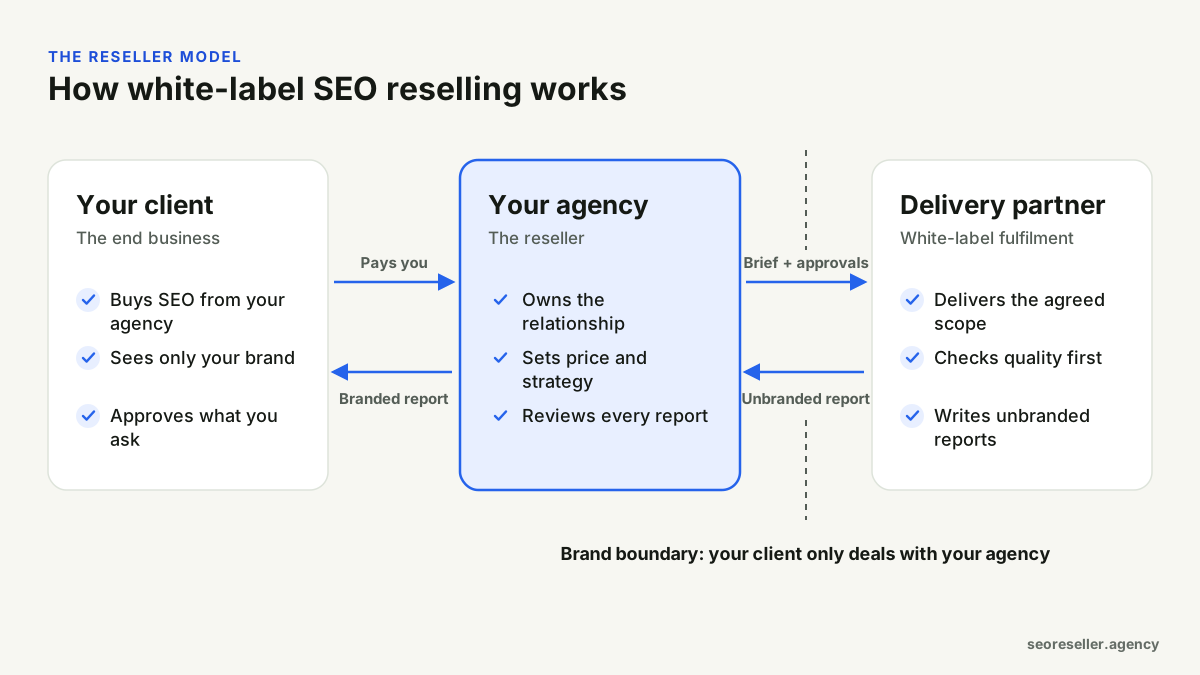
An SEO reseller is an agency, consultant or other business that sells SEO services to its own clients while some or all of the work is delivered by a separate fulfillment partner. In the most common model, white-label reselling, the partner's name never appears: the reseller sets the price, owns the client relationship and forwards unbranded reports under its own brand.
Key takeaways
- The reseller owns the client, the price and the strategy; the partner delivers an agreed scope.
- White-label and private-label both hide the partner's brand. Referral and affiliate models don't: the client buys from the provider directly.
- Reselling works when the scope is defined in units and the reseller can check every deliverable.
- The reseller stays accountable to the client for everything sold, including the partner's work.
SEOReseller provides white-label SEO delivery, so we have a commercial interest in this topic. The definitions below apply to any provider.
The definition, in one paragraph
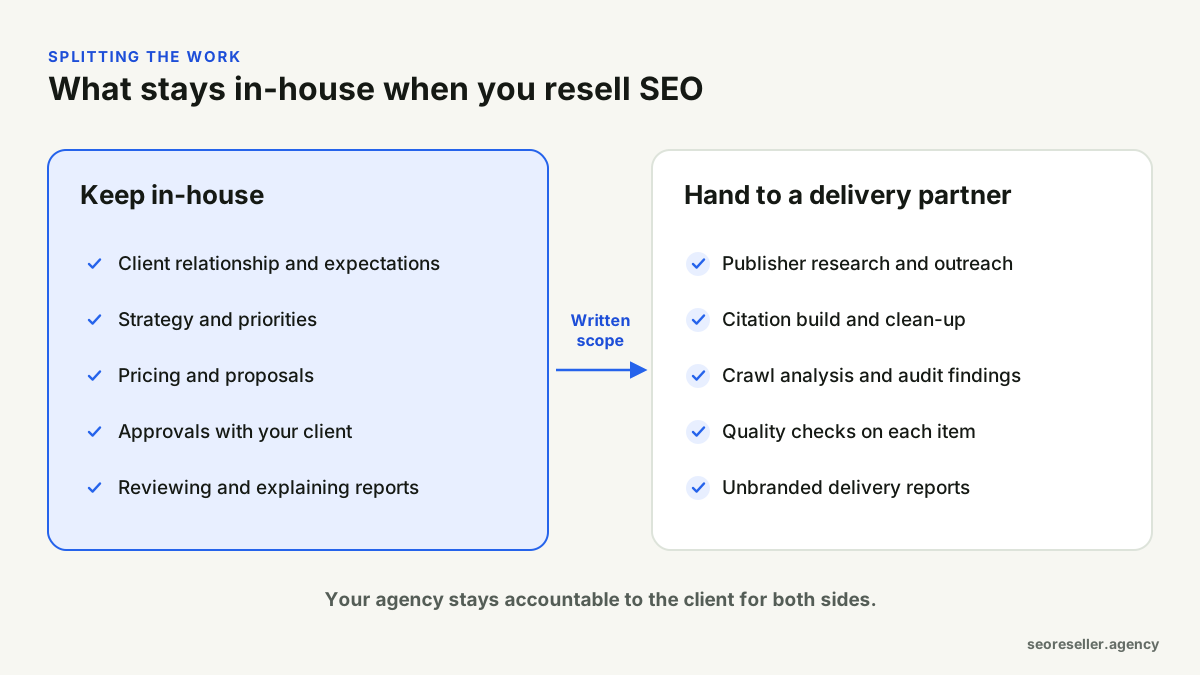
An SEO reseller sells search engine optimisation services to its own clients and uses a separate business, a fulfillment partner, to deliver part or all of that work. The reseller decides what to sell and at what price, manages the client and is accountable for the result. The partner delivers an agreed scope, documents it and hands back reports the reseller can pass on.
The phrases "SEO reseller program", "white-label SEO" and "private-label SEO" all describe versions of this arrangement. They differ mainly in whose brand the client sees and who holds the client relationship.
The four reseller models compared
| Model | Whose brand the client sees | Who owns the client | Who sets the client price |
|---|---|---|---|
| White-label | The reseller's only | Reseller | Reseller |
| Private-label | The reseller's only, often with the partner embedded in the reseller's own processes or tools | Reseller | Reseller |
| Referral | The provider's | Provider, after the introduction | Provider |
| Affiliate | The provider's | Provider | Provider (reseller earns a commission) |
In practice, white-label and private-label are often used interchangeably. Where people do distinguish them, private-label usually means a deeper arrangement: dedicated people, tools or processes that run inside the reseller's own operation, rather than per-order fulfillment. Referral and affiliate arrangements are not really reselling: the client becomes the provider's customer.
How a white-label arrangement works
- The reseller sells. It agrees goals, scope and price with its client under its own brand.
- The reseller briefs the partner. It sends the service, quantity, market and any exclusions, without passing on client logins.
- The partner scopes and quotes. A good partner confirms what's deliverable in writing, with units, exclusions and terms.
- Approvals and access. The client grants any account access by invitation; the reseller approves targets or content where the scope requires it.
- Delivery and quality checks. The partner does the work and checks it before reporting.
- Unbranded reporting. The partner sends a report without its branding. The reseller reviews it, adds commentary and forwards it.
What services are commonly resold
Services that break into clear units and produce verifiable evidence resell best, because the reseller can check them:
- Link building: research, outreach and placements, reported with live URLs and link attributes. See white-label link building.
- Local SEO: per-location audits, citation work and approved profile tasks. See local SEO reseller services.
- SEO audits: a technical and on-page diagnosis with a prioritised action plan. See white-label SEO audits.
- Content production: articles to an agreed brief, where a partner offers it.
Open-ended work such as "full SEO management" is harder to resell well. Without units, neither the reseller nor the client can tell what was delivered.
Who reselling suits, and who it doesn't
| Situation | Reselling is often a good fit | Reselling is often a poor fit |
|---|---|---|
| Demand | Clients ask for SEO but volume doesn't justify a hire | Steady, high volume that would keep a specialist fully busy |
| Skills | You can judge quality but don't want to run delivery | You can't evaluate the work you're selling |
| Clients | You already hold the relationship and trust | You'd be selling to strangers on price alone |
| Control | Defined units and written approvals are enough | Every task needs your direct, daily control |
Benefits and risks
Benefits
- Offer services without hiring, training or managing specialists.
- Costs follow orders instead of salaries.
- Keep the client relationship and your positioning.
Risks
- Quality you can't see: if reports aren't verifiable, problems surface with the client first.
- Policy risk: a partner that sells links meant to pass ranking credit, or creates fake business listings, puts your clients at risk.
- Margin erosion: your own account management time is easy to forget when pricing. See SEO reseller pricing.
Before you start reselling
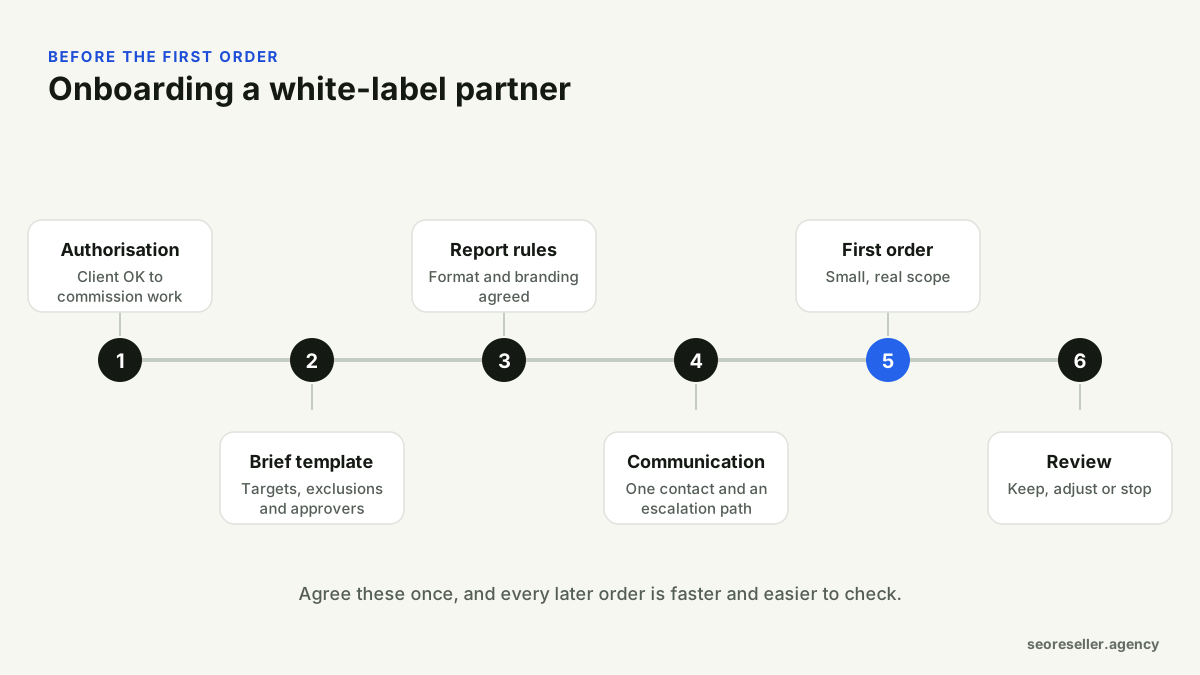
- Pick two or three services clients already ask for
- Write down each one in units: placements, locations, sites
- Choose a partner on evidence, starting with a sample report
- Price from total cost, including your own time
- Agree report format and client-contact rules up front
- Start with one small, real order
To see how one white-label partnership is set up in practice, read how the SEO reseller program works and look at the sample reports.