What a white-label SEO report should include
SEOReseller guide · Publishes · 3 min read
Short answer
A white-label SEO report should let your client check what was delivered against what was agreed. That means the scope, each deliverable with its evidence and date, clear status definitions, anything outstanding, the report's own limits, and next steps, all without the partner's branding. It should not imply results that the work alone can't prove.
Key takeaways
- A good report lets the client check delivered work against what was agreed.
- Every item needs evidence and a date; statuses need definitions.
- State the report's limits, and never imply that deliverables proved ranking changes.
- Add your own summary and next steps before forwarding.
What the report is for
A white-label report has two readers: you, checking that your partner delivered what you paid for, and your client, deciding whether they got what they paid you for. A good report serves both by being verifiable. Anyone should be able to open a URL, check a listing or reproduce a finding from what's written.
Elements every report needs
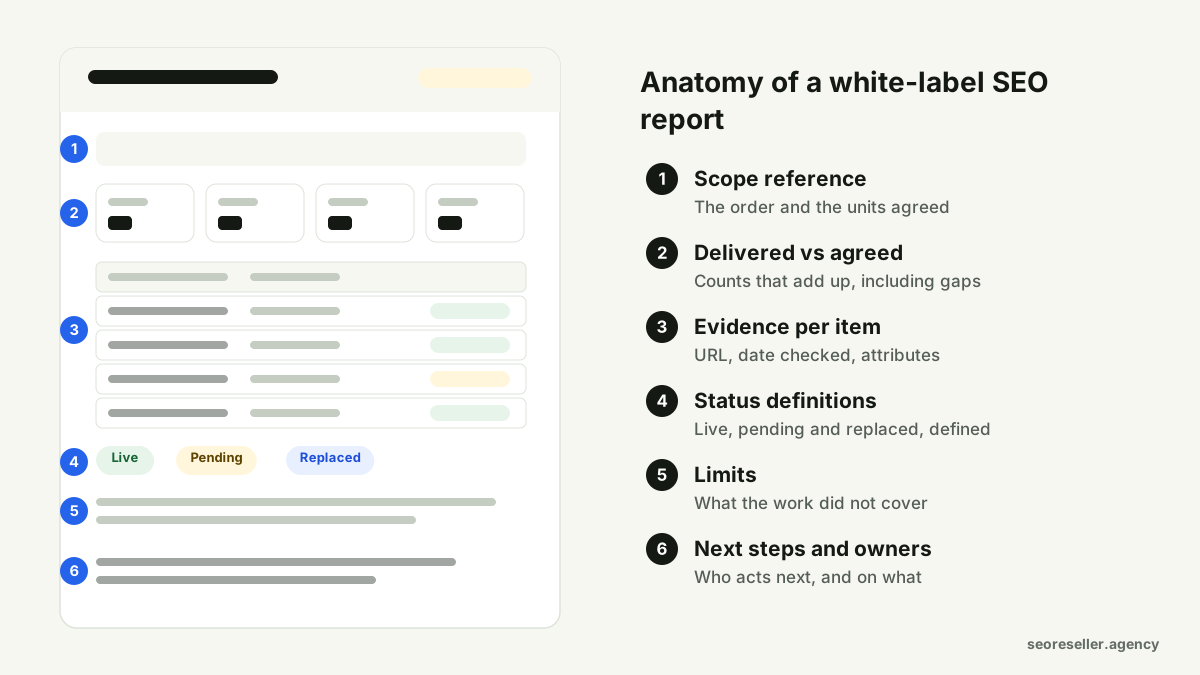
- Scope reference: the order or agreement it reports against, with the units agreed.
- Delivered versus agreed: a count that adds up, including partial, replaced and blocked items.
- Evidence per item: a live URL, listing URL, screenshot or tool output, whatever proves it exists.
- Dates: when work was completed and when evidence was checked. Third-party metrics without a date are hard to interpret.
- Status definitions: what "live", "pending" or "replaced" mean, so nobody reads a pending item as done.
- Limits: what wasn't covered, such as crawl limits, sections excluded or tools not used.
- Next steps and owners: what happens next and who has to act, especially when your client needs to approve something.
Service-specific details
Link building
- Live URL, target URL and anchor text for each placement.
- Link attributes as published (for example rel="sponsored" or rel="nofollow") and any sponsored labelling.
- Why the site qualified: topical fit and traffic evidence with the date it was checked.
- Replacements, with the reason and the original site.
Local SEO
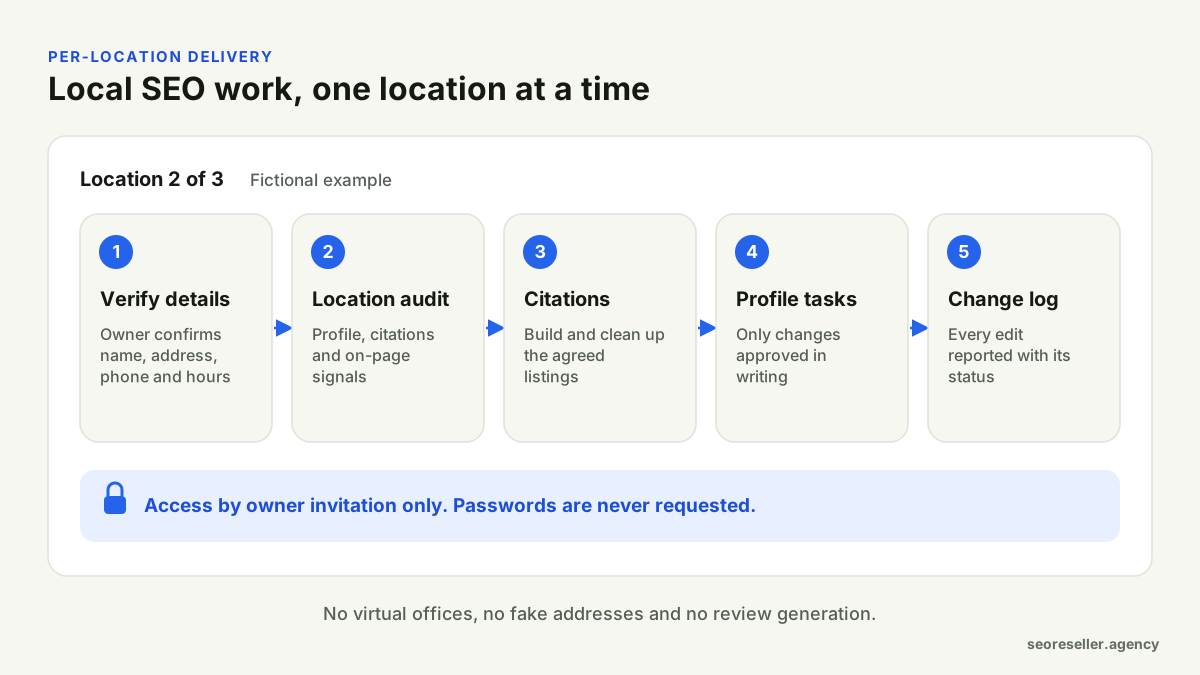
- One section per location, so multi-location clients can see each one separately.
- Each citation with its directory, listing URL, action taken and current status.
- A change log for profile edits: field, before, after, date and who approved it.
- Duplicates found and the decision taken, and which access the client can now revoke.
SEO audits
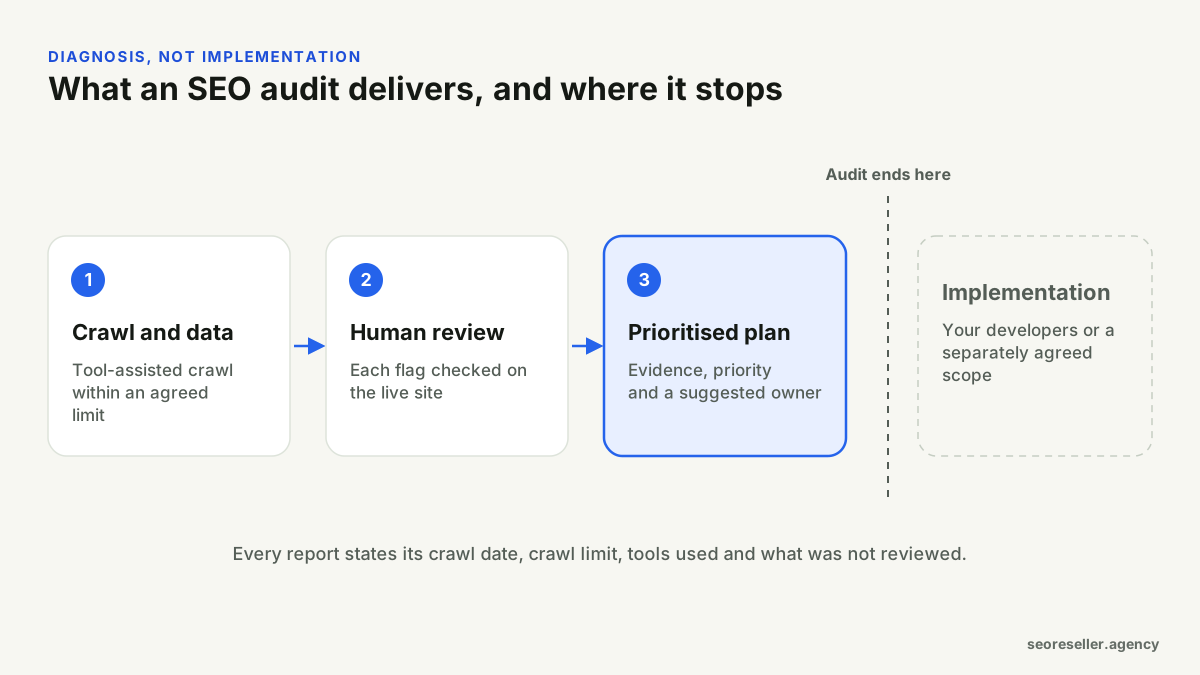
- Crawl date, crawl limit, tools used and sections not reviewed.
- Each finding with evidence, affected URL samples, priority and a recommended fix.
- A suggested owner for each fix (developer, content, SEO) so the plan can be assigned.
- A clear statement that the audit is diagnosis, not implementation.
What to leave out
- Ranking or traffic charts placed next to deliverables as if one caused the other.
- Third-party authority scores presented as a measure of value on their own.
- Undated metrics, or totals that don't match the itemised list.
- Jargon your client can't act on. Add a plain-language summary instead.
Add your own layer before forwarding
The partner's report covers delivery. Your client also needs your interpretation: how this work fits the strategy, what you recommend next and what you're watching. A short cover note from you usually does more for client confidence than a longer report.
Report review checklist
- Every agreed unit is accounted for, including replacements and blockers.
- Every item has evidence and a date.
- Statuses are defined and used consistently.
- Limits and exclusions are stated.
- Nothing implies guaranteed or proven ranking outcomes.
- No partner branding or internal notes remain.
- Your own summary and next steps are added.
You can see these elements in practice in our sample reports, built with fictional data. For link-building delivery specifically, see white-label link building.