Industry guide for agencies
White-label SEO for dental practices
What matters when your agency sells SEO to dental practices: how their customers search, what to prioritise, and what to avoid.
Priority order for this industry

Short answer
Higher-stakes topicFor dental practices, SEO is mostly local: patients search for a dentist near them, for a specific treatment, or for an emergency appointment. Agencies reselling SEO to dentists should prioritise accurate per-location profiles and citations, treatment pages that are clinically accurate and reviewed by the dentist, and fast mobile pages with clear booking routes. Health content is held to a higher accuracy standard, and patient privacy limits how reviews can be answered.
Content for dental practices can affect people's health, money or legal position, so search engines and readers expect it to be especially accurate. Have a qualified professional at the client review it.
How dental practices' customers search
- Most searches combine a treatment or need with a place: implants, emergency dentist, children's dentist near me.
- Urgent searches such as broken tooth or dental pain often come from mobile users who want to call immediately.
- Patients compare practices on reviews, opening hours, insurance or payment options and photos of the practice.
- Treatment research such as Invisalign versus braces happens weeks before a booking, which suits well-written treatment pages.
What to prioritise, in order
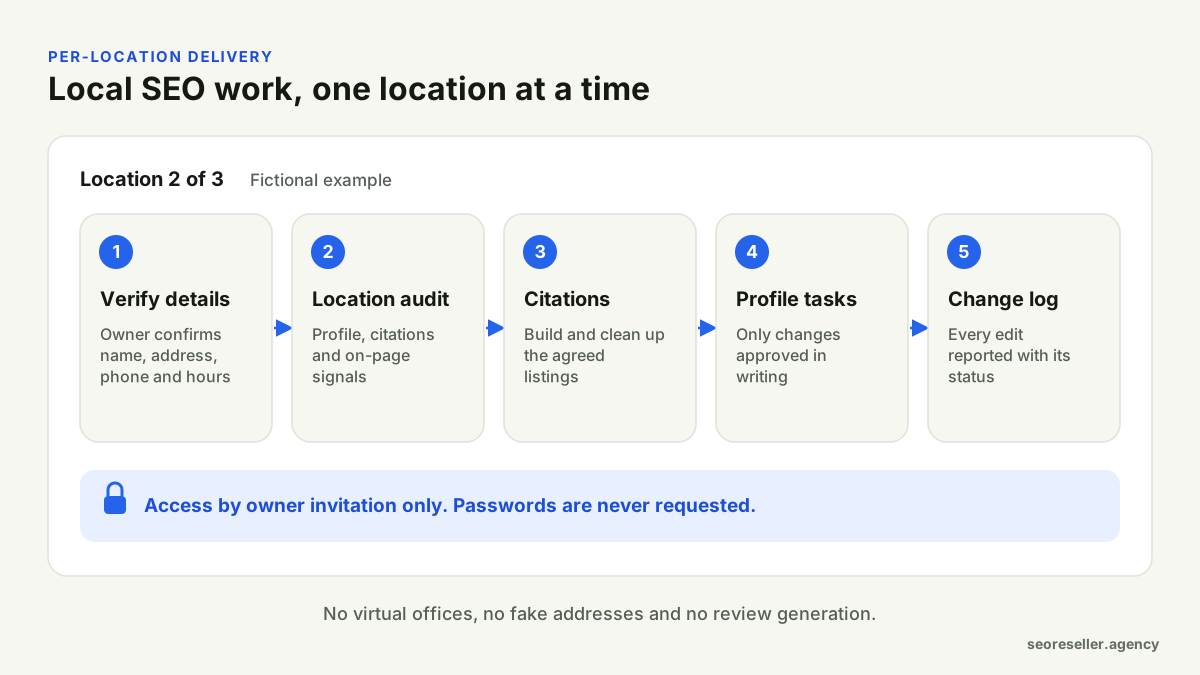
Map results drive many dental bookings. Each practice location needs an accurate profile, correct categories and consistent citations on general and health directories.
Practice websites are often template-built with thin treatment pages, slow image-heavy galleries and booking widgets that hide content from crawlers. An audit finds what's worth fixing first.
Useful later rather than first: placements on local community, health-information and regional news sites can support treatment pages once the local foundations are sound.
Accuracy and compliance cautions
- Dental content is health information. Treatment pages should be accurate and reviewed by a qualified clinician, and they shouldn't promise outcomes.
- Review responses must not confirm someone is a patient or discuss their care. In the US, health privacy rules such as HIPAA make this a real legal risk, not just etiquette.
- Before-and-after photos need documented patient consent, and advertising rules for dentists vary by state or country.
- Titles such as specialist are often regulated; use only what the dentist is entitled to claim.
General guidance, not legal advice. Rules vary by country, state and profession.
What an audit should focus on
- One page per treatment with substantive, clinician-reviewed content, rather than a single services list.
- Booking widgets or iframes that crawlers can't read, leaving key pages nearly empty.
- Large before-and-after galleries hurting mobile loading on the pages patients use most.
- Consistent practice name, address and phone between the website, profile and directories.
- Location pages for multi-site groups that genuinely differ: team, hours, services and directions.
Where relevant links come from
- Local community sites, school and sports club sponsorships with genuine involvement, and regional news covering the practice.
- Health-information publishers where a dentist contributes accurate, expert content in their own name.
Relevance and real readership matter more than any authority score. Paid placements should be labelled as sponsored.
Questions to ask before you brief a partner
- Which treatments does the practice most want to grow, and which does it not offer?
- How many locations, and does each have its own phone number and team?
- Who reviews clinical content before publication?
- What booking system is used, and does it run on the practice's own domain?
- Are there regulatory limits on advertising claims in the practice's state or country?
Frequently asked questions
Should each dental treatment have its own page?
Can we reply to negative dental reviews?
Ready to scope SEO for a client in this industry?
Share the service, rough scope and market. You'll get a written scope and quote to review. Nothing starts until you agree to it.
- You keep the client relationship
- Unbranded deliverables
- Written scope before work starts